




There is an exceptional level of vulnerability one must be willing to experience to be a mental health clinician. This is true in the room with clients, but also in our interactions with other members of our profession. Early on, graduate students are often taught that there is a right way to be a good therapist. In practice, this can push clinicians to avoid any perceived shortcomings in knowledge or ability from clients and colleagues alike.
Perfectionism is a difficult trap, as it often promises success, relief, and impenetrable armor against criticism while delivering only burnout, depressive symptoms, and avoidance. Multiple studies over the past 30 years have highlighted the correlation between perfectionism and depressive symptoms (Enns & Cox, 1999; Frost, Heimberg, Holt, Mattia,& Neubauer, 1993). The mental health counseling profession is no exception, with high rates of maladaptive perfectionism in counselors, some research showing rates as high as 61%. Therapists with maladaptive perfectionism become chronically stressed by perceiving their best efforts as insufficient to meet high personal standards and external demands. This perpetual feeling of notmeasuring up contributes to burnout (Moate, Gnilka, West, & Bruns, 2014).
These variables create a cycle of distress and behavior that can feel difficult to escape, the ‘Good Therapist ’Trap:
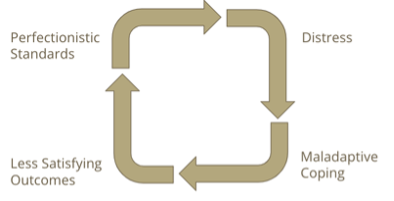
For those who ruminate endlessly about what was or wasn’t said in a session, research constantly for the exact right treatment modality, or try to hide during consultation meetings to avoidsuspicion of incompetence, this may be more than anxiety. It may be perfectionism. There are ways to get out of this trap; though like the work weask of our clients, it isn’t easy. I speak from experience as a therapist whohas engaged in many of these behaviors and who often finds himself fused tothoughts like, “I should be better at this by now.” I still find myself stuck in the trap occasionally, but stepping back allows me to notice it and moveforward.
To be clear, there is no such thing as the perfect therapist. The work doesn’t allow for it. Our experiences with clients are as wide-ranging as theirs, and as we pursue therapeutic goals, there will be bumps: misunderstandings, failed attempts, and so on. But the number one variable associated with positive therapeutic outcomes is the strength of the therapeutic relationship (Stubbe, 2018). If clients feel understood, connected, and that we have their best interests in mind, goals are more likely to be met, and bumps are usually recoverable. Connection provides the strength and flexibility needed for this journey.
This points to how we begin to resist the spiral of the Good Therapist Trap: connection is a process, not an end goal. We never fully “arrive” at connection. When we engage with clients authentically, showing up with curiosity, presence, and flexibility (myvalues!), connection occurs naturally. It isn’t about perfection—it’s about how we show up.
With this in mind, consider how you want to show up in your sessions, and don’t say “perfectly.” Identifyvalues and behaviors associated with those values that you can move toward, even if you never fully arrive. For example, I often want to be seen as smart and competent. Control over how others perceive me is limited. Focusing on that leads to rumination and avoidance. Instead, I choose values: present, curious, flexible. Moving toward these values means engaging in active listening, focusing on what the client is saying and feeling, and meeting the client wherethey are without overholding my perspective.
Even here, success isn’t guaranteed. The work is too human for that. Yet moving toward values through behavior, even while anxious or self-critical, tends to strengthen the therapeutic relationship and outcomes. Ask yourself: how do I want to show upfor this next session? Identify 2–3 values that reflect this. What behaviors move you toward these values? Make a list. Remind yourself that no one lives their values perfectly. This is about engaging in the process, not judging outcomes you can’t fully control. Failure is inevitable, and it’s within those moments that we learn, grow, and become stronger. The goal isn’t to avoid failure. It’s to notice opportunities for growth and invest in connection so failure is recoverable.
The “Good Therapist” trap doesn’t loosen because you finally get good enough. It loosens when you stop organizing your work around that idea. You will miss things. You will feel unsure. You will have sessions you wish you could redo. None of that disqualifies you. Thequestion isn’t whether you can eliminate those experiences, but whether you’re willing to show up in a way that reflects your values while they’re happening. Because in the end, the therapists who sustain this work aren’t the ones who get it right. They’re the ones who stay engaged, stay flexible, and keep choosing connection over perfection (or whatever your values are!).
References
Enns,M. W., & Cox, B. J. (1999). Perfectionism and depression symptom severity in major depressive disorder. Behavior Research and Therapy, 37, 783–794.
Frost,R. O., Heimberg, R. G., Holt, C. S., Mattia, J. I., & Neubauer, A. L.(1993). A comparison of two measures of perfectionism. Personality andIndividual Differences, 14, 119–126.
Moate,R. M., Gnilka, P. B., West, E. M., & Bruns, K. L. (2016). Stress and burnout among counselor educators: Differences between Adaptive Perfectionists, maladaptive perfectionists, and non-perfectionists. Journal of Counseling& Development, 94(2), 161–171. https://doi.org/10.1002/jcad.12073
Stubbe DE. (2018). The Therapeutic Alliance: The Fundamental Element of Psychotherapy. Focus (Am Psychiatr Publ). 2018Oct;16(4):402-403.


