


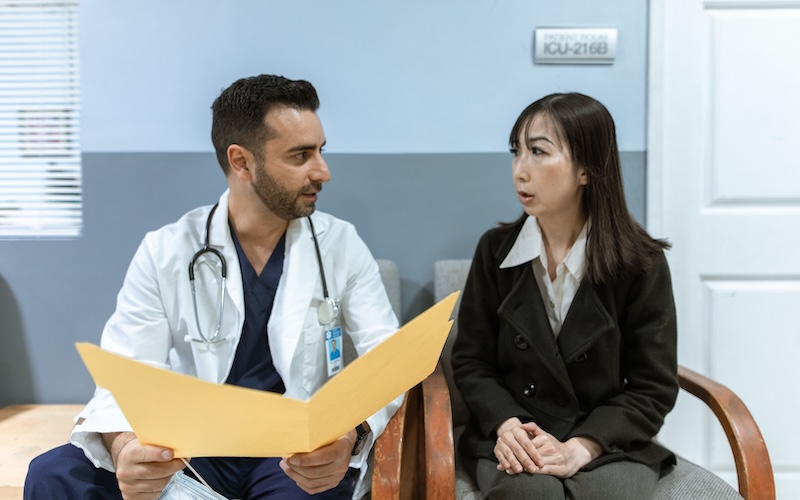
“I was eating ice cream earlier. Maybe my face is just numb from the cold food?” I desperately joked to the emergency room physician. It was a joke, but I truly wanted him to turn to the room and announce, “Guys, she ate ice cream! Cancel the MRI! Whew, you’re lucky this is just facial paralysis from eating super cold food! Get out of here and lay off the cold treats!” But the doctors and nurses continued with their flurry of questions and needle pokes in an attempt to rule out a stroke.
It wasn’t the ice cream. And fortunately, it also wasn’t a stroke! After a few hours in the emergency room, I was diagnosed with Bell's Palsy. The condition causes sudden facial paralysis and can affect everything from blinking and smiling to hearing and tasting. Most people recover fully, but recovery can take weeks or months, and there is no way to know exactly what that timeline will look like.
While I was relieved that my symptoms weren’t the result of something more serious, the uncertainty about what my progress would look like and how long it would take was challenging to sit with. Despite my providers’ confidence that I would make a full recovery, I became consumed with anxiety and an endless stream of “what ifs.” “What if my smile never looks the same again?,” “What if I never blink my left eye again?,” “What if my ear never stops ringing?” I found myself attempting to relieve my anxiety by researching health information online, excessively checking my progress, and seeking reassurance. Nearly a decade of helping others manage anxiety had not prepared me for the challenge of facing this anxiety myself.
There is no amount of knowledge or experience that can make a difficult situation not difficult. I had to remind myself of this often, as self-critical thoughts about what I “should” be able to handle made their appearance. The statement may sound hopeless, but for me it was validating. It meant that it’s normal to struggle with such an experience and that any human experiencing it would feel the same way. Showing myself compassion allowed me to open the door to difficult feelings, rather than layering self- judgment on top of them. It’s hard enough to feel anxious, let’s spare ourselves the emotions casserole by adding shame and guilt.
Once I opened the door to allow difficult feelings to be there, I found it difficult to keep that door open. Every part of me wanted to close the door as I didn’t want to sit with these emotions, sensations, and urges; I wanted to do whatever I could to get rid of them. I found the ACT skill of expansion especially helpful when the urge to search for certainty showed up. Observing and describing what was happening in my mind and body, breathing into and around the discomfort, and giving these experiences permission to be there felt empowering, even amid discomfort. While practicing expansion, sometimes I would say to myself, “You’re here. You’re doing it. This is the thing you wanted to escape. Look at you co-existing with it!”
In many ways, that became a coping statement for me. As a therapist, I often help clients create coping statements to stay resilient during distress. For me, coping statements helped me stay aware of anxiety’s “tricks” and reminded me of the importance of building my tolerance of uncertainty about my health. A few of the statements that I used included, “Urgency does not equal emergency,” “Uncertainty is uncomfortable and searching for answers won’t get rid of it,” and “I can live in the same space as these thoughts and feelings.”
I don't want to give the impression that I used a skill and then suddenly stopped struggling with anxious uncertainty. My journey with health anxiety has included moments of practicing these skills and moments of searching Google in an attempt to predict the future (unsuccessfully). It was there when I joyfully watched a best friend unwrap baby shower gifts. It showed up again when another friend and I enjoyed our annual fancy restaurant dinner. Bell's Palsy reminded me that a meaningful life isn't found on the other side of anxiety and uncertainty, it can exist alongside them.


